In January 2026, Brent crude oil traded at roughly $67 per barrel. By the end of March, it had surged past $112 — a 67% increase in under 90 days, driven by escalating conflict in the Middle East and disrupted shipping routes.
If you manufacture paper tubes, protective edges, or honeycomb cores using PVAc or PVOH adhesives, that number matters to you — even if your adhesive supplier has not raised prices yet. Because the real cost of oil-based adhesives is never just the price on the invoice.
The Direct Link: Crude Oil to Your Production Floor
PVAc (polyvinyl acetate) adhesives are manufactured from vinyl acetate monomer, or VAM. VAM is produced from ethylene and acetic acid — both petrochemical derivatives that track crude oil and naphtha prices with a typical lag of 4 to 8 weeks.
In Q3 2025, VAM prices in the US reached $1,340 per metric ton, driven by stronger demand in adhesives and coatings. With Brent crude now trading 67% higher than it did at the start of the year, the pressure on VAM pricing is not a question of “if” — it is a question of “when” and “how much.”
The math is straightforward: when your adhesive’s primary raw material is derived from crude oil, every geopolitical event, every OPEC decision, and every pipeline disruption feeds directly into your production cost.
The Five Hidden Costs You Are Already Paying
Most procurement teams evaluate adhesives on one metric: price per ton. But for oil-based adhesives, the true cost includes at least five additional layers that rarely appear in the initial quote.
1. Price Volatility Risk
The most obvious hidden cost is unpredictability. Over the past 18 months, Brent crude has ranged from $60 to over $112 per barrel — a spread of nearly 90%. This volatility makes it nearly impossible to budget adhesive costs with confidence beyond 30 days.
For a mid-size paper tube manufacturer consuming 50 tons of adhesive per month, even a 10% raw material increase translates to thousands of euros in unplanned cost per quarter.
2. Supply Chain Fragility
Petroleum-based adhesive supply chains are global and linear: crude extraction (often Middle East or Russia) to refinery to petrochemical complex to VAM producer to adhesive manufacturer to you. Every link in that chain is a potential failure point.
In early 2026, disrupted shipping routes through the Strait of Hormuz added weeks of delay and spiked marine insurance premiums. Your adhesive may be manufactured in Europe, but its raw materials are not.
3. Currency Exposure
Crude oil is traded in US dollars. For European manufacturers purchasing PVAc adhesives, a weakening euro against the dollar creates a double hit: rising commodity prices amplified by unfavorable exchange rates. In Q1 2026, the EUR/USD pair dipped below 1.05, adding an estimated 3-5% cost premium.
4. Regulatory and Compliance Pressure
The EU’s evolving sustainability framework is adding cost pressure to petrochemical products. Extended Producer Responsibility (EPR) schemes, carbon border adjustment mechanisms (CBAM), and tightening VOC emission standards all increase the compliance burden for petroleum-derived adhesives.
5. Recycling Compatibility
Paper products bonded with petroleum-based adhesives can create challenges in the recycling stream. Dextrin-based adhesives, by contrast, are water-soluble and fully compatible with standard paper recycling processes — a technical advantage that translates directly into market access.
The Alternative: Agricultural Stability vs. Petrochemical Volatility
Dextrin adhesives are manufactured from potato starch and water. Potato starch is an agricultural commodity produced primarily in Northern Europe.
- 12-year CAGR of +2.5% — gradual, predictable increases
- Local supply chains: European farms, European facilities, road delivery — no ocean freight, no geopolitical chokepoints, no dollar dependency
While crude oil swung 90% in 18 months, potato starch prices moved within a single-digit percentage band.
Quantifying the Switch
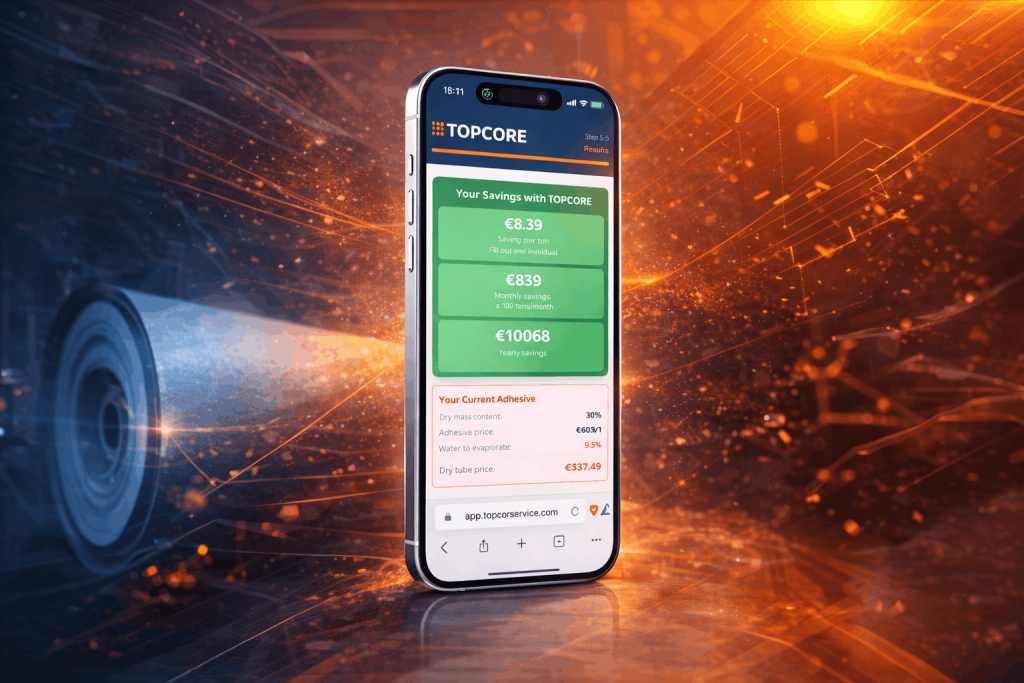
Every production setup is different. That is exactly why TOPCORE built the Adhesive Savings Calculator — a tool that takes your specific production parameters and delivers a side-by-side comparison.
The calculator accounts for: adhesive price per ton, application rate and waste, water savings (up to 70% with powder format), and transport costs.
Manufacturers who have used the calculator typically discover 15-30% total cost reduction — before accounting for the volatility premium and supply chain risk.
Try it yourself: app.topcoreservice.com
Beyond Cost: The Strategic Case
- Supply security: Locally sourced raw materials, no exposure to shipping route disruptions
- Regulatory alignment: Borax-free, eco-certified formulations meeting current and emerging EU standards
- Customer demand: End brands increasingly require sustainable material choices
- Technical support: Custom formulations matched to your specific paper, machinery, and production process
What a Transition Actually Looks Like
- Technical assessment: TOPCORE analyzes your current setup and requirements
- Custom formulation: A dextrin adhesive developed for your specific application
- On-site testing: Trial runs on your production line with TOPCORE support present
- Gradual rollout: Scale from test line to full production with ongoing optimization
The Bottom Line
Oil-based adhesives carry costs that do not appear on any invoice: volatility risk, supply chain fragility, currency exposure, regulatory pressure, and recyclability limitations. In 2026, with Brent crude above $110 per barrel, these hidden costs are larger than ever.
Dextrin adhesives made from potato starch and water offer something that petroleum chemistry cannot: predictable, locally sourced, ecologically sound raw materials with stable pricing.
The question is not whether oil prices will affect your adhesive costs. They already are. The question is what you are going to do about it.
Calculate your potential savings today: app.topcoreservice.com
Or book a free consultation: Schedule a call